
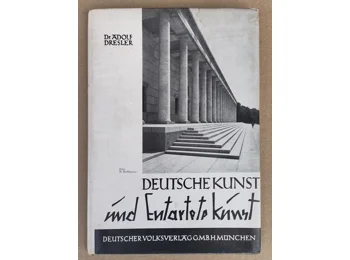


Original Third Reich book German Art and Degenerate "Art"
Product Code: cneQlIy
Rating: Be the first to write a review
Product Condition: Used
Complete edition in the original publisher's binding,with the original dustjacket, 15 x 21 cm, with photo-illustrated title on the cover. 80 pages (32 text and 48 image pages) with numerous photographic illustrations by Erika Schmauß on art paper.First edition in good condition. Featuring illustrations of works by Otto Dix, Elk Eber, George Groß, Ferdinand Spiegel, Walther Hoeck, Hermann Tiebert, Adolf Ziegler, Schmidt-Rottluff, Franz Eichhorst, Paul Roloff, Hans Jakob Mann ("Abbot Albanus Schachleiter"), Oskar Kokoschka, Thomas Baumgartner, Adolf Wissel, Max Beckmann, Josef Damberger, Paul Klee, Kurt Schwitters, Rudolf G. Werner, Heinrich von Richthofen, Emil Nolde, Eduard Schloemann, Hugo Hodiener, Rudolf Sieck, H. Kampendonk, Herbert Molwitz, Hermann Paul Simon, Max Betzner, Georg Kolbe, and Fritz Klimsch.
A juxtaposition of 56 original exceptions from the "House of German Art" and the "Degenerate Art" exhibition, with captions such as: "Sculpture of the liberal age. Sculpture was just as degenerate as painting. Only deformed idiots were presented to the people as 'works of art'" / "What these two pictures by Rohlfs and Kerkovius are supposed to depict is impossible to guess... But they are said to be landscapes. The snob who bought it as a painting was always found—from the black marketeer to the museum director and Reich art curator" / "At all times, praising one's homeland has been one of the most beautiful tasks of the creative artist. But what did the German landscape mean to the Jewish desert people and their perverse followers?" Thus, the landscape painting also became a nasty distortion” / Hans Schwitters. In March, the Dresden Gallery purchased the painting “Bildpunkt” for 14,000 DM using German taxpayers' money. The accompanying statements, typical of the time, included: “Simultaneously with the resurrection of the German people, we are experiencing the rebirth of German art. The two are inseparable, for art is the living component of a people and the true reflection of its inner life. In the pre-war period, German art had begun to detach itself from the people. The artists forgot the eternal truth that no art can live without a living connection to the people.” And when, in the post-war period, the German people were politically divided and heading towards moral decay, art became a distorted reflection of this disease process, degenerating into an often frightening depiction of uprooted spiritual life and exaggerated intellectualism.
Visual arts of the Weimar Republic and under National Socialism, German/Third Reich, nationalist art studies and art history, art appreciation/interpretation in Germany before 1945, art criticism in the German National Socialist state, Nazi art, degenerate art, healthy national sentiment, so-called Jewish-Bolshevik literary cliqueArt trade in Jewish hands during the Weimar Republic, so-called Jewish-Bolshevik art writers, artistic degeneration during the Nazi era, Bolshevization of German cultural life before 1933, Jewish conspiracy against German art, racial characteristics of the Aryan race, Reich Art Warden Redslob, antisemitism, the fight against cultural Bolshevism in Germany, racially appropriate/representational art under Adolf Hitler, Nazi art, German painting and sculpture in the 20th century, the fight against artistic Bolshevism, Nazi art aesthetics, völkisch/National Socialist ideology.
Customer Reviews
No Reviews Posted Yet - be the first! (write review)